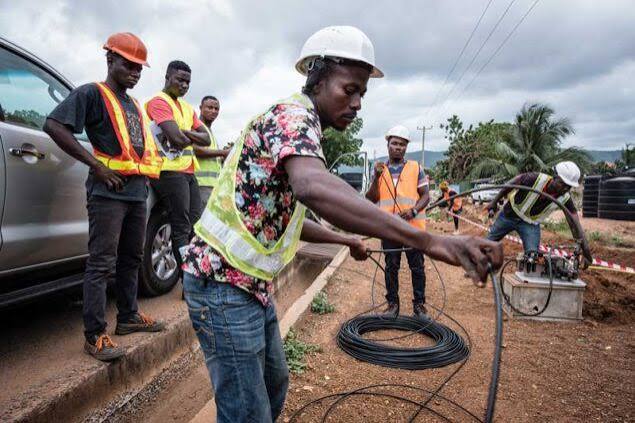
One damaged cable can look insignificant.
Until millions of people lose internet access.
That is essentially what Ghana experienced on September 26, when multiple fibre cuts disrupted voice and data services across all five northern regions and parts of the Oti Region.
According to the National Communications Authority, the disruption affected three separate transmission routes carrying telecommunications capacity into the affected areas. Read the NCA service-disruption notice
2G, 3G and 4G services were all affected.
Technical teams eventually restored connectivity.
But the incident exposed a much bigger problem.
How resilient is Ghana’s internet infrastructure when several fibre routes fail at once?
The internet is more physical than it looks
The internet often feels invisible.
Open an app, send a message, stream a video, Everything seems wireless.
But most internet traffic eventually travels through physical cables.
Those fibre-optic cables carry enormous volumes of data between cities, mobile towers, data centres and international networks.
Damage the wrong fibre route and thousands of towers can suddenly lose the connection behind their wireless signal.
That is what made the September outage significant.
The NCA said multiple cuts affected three transmission routes and caused outages and service degradation across a substantial number of network sites.
So even though someone may still see a mobile-network icon on their phone, the infrastructure behind that signal may no longer have a functioning path to the wider network.
This is not the first time fibre cuts have caused disruption
Earlier in March, MTN users in parts of Greater Accra also experienced service interruptions after three transmission fibre cables were cut.
The incident affected 57 2G sites, 57 3G sites and 57 4G sites, as well as some fixed fibre broadband services. See the NCA’s March service notice
That shows the issue is not limited to northern Ghana.
Fibre damage can affect networks anywhere.
The causes can vary; road construction, excavation,utility work, accidental damage, poorly coordinated infrastructure projects or deliberate vandalism.
Whatever the cause, the effect can be the same: entire communities suddenly lose digital access.
Redundancy is supposed to prevent this
Modern telecom networks are designed with redundancy.
That means there should ideally be another path for traffic if one route fails.
Think of it like travelling from Accra to Kumasi.
If one road is blocked, there should be another route available.
The problem appears when several routes fail at roughly the same time or when backup capacity is not strong enough to carry the traffic.
The northern outage is therefore important because the NCA said three separate transmission routes were affected.
That puts pressure on the backup architecture.
The question becomes:
How many failures can Ghana’s network handle before entire regions begin losing service?
Internet outages are now economic disruptions
A decade ago, losing mobile data for several hours might have mostly meant inconvenience.
Today, the consequences are much larger.
People use mobile networks to:
- send and receive mobile money
- run businesses
- access cloud applications
- communicate with customers
- study online
- use digital government services
- coordinate transport
- work remotely
That means telecom resilience has become economic infrastructure. A market trader who cannot confirm a mobile-money payment has a problem. A company whose staff cannot access cloud systems has a problem. A hospital or public institution relying on connectivity has a problem. Internet outages are no longer simply a telecom issue, they can interrupt everyday economic activity.
Rural areas may feel the impact more
Infrastructure redundancy is usually easier to build in large cities.
There are more fibre routes, more towers, and more customers.
And stronger commercial incentives for operators to invest.
Less densely populated areas can be more difficult.
Building multiple fibre routes to the same location is expensive.
But that also means those communities can become more vulnerable when a major transmission path fails.
Ghana’s ongoing push to expand 5G and rural connectivity therefore raises another question.
Building more towers is useful.
But are we also building enough resilient transmission infrastructure behind those towers?
A 5G tower without reliable backhaul is still a weak network.
Ghana fixed the outage. The lesson remains.
The September disruption did not last indefinitely.
The NCA later confirmed that network operators and the National Information Technology Agency had repaired the damaged infrastructure and restored voice and data services across the affected regions. Read the NCA restoration update
That is good, but resilience is not measured only by whether engineers can repair a cable. It is also measured by whether users notice the failure in the first place.
The strongest infrastructure is designed so that traffic automatically moves elsewhere while repairs happen. That requires investment, more routes, better monitoring and Faster fault detection.
And better coordination around where fibre cables are located.
Ghana’s digital economy needs physical protection
Ghana is pushing hard on digital transformation.
5G, Open banking, AI, Digital government, Fintech and Cloud services.
All of those depend on something much less glamorous:physical infrastructure, Cables buried underground, Towers, Data centres, Power systems and International fibre links.
The digital economy only works when those physical systems keep working.
The September outage should therefore be seen as more than a temporary network problem.
It is a reminder that digital transformation is only as strong as the infrastructure underneath it.
Ghana does not simply need faster internet. It needs internet that can survive when something breaks.
Writer at TechNews.

Comments 0
No comments yet — start the conversation.