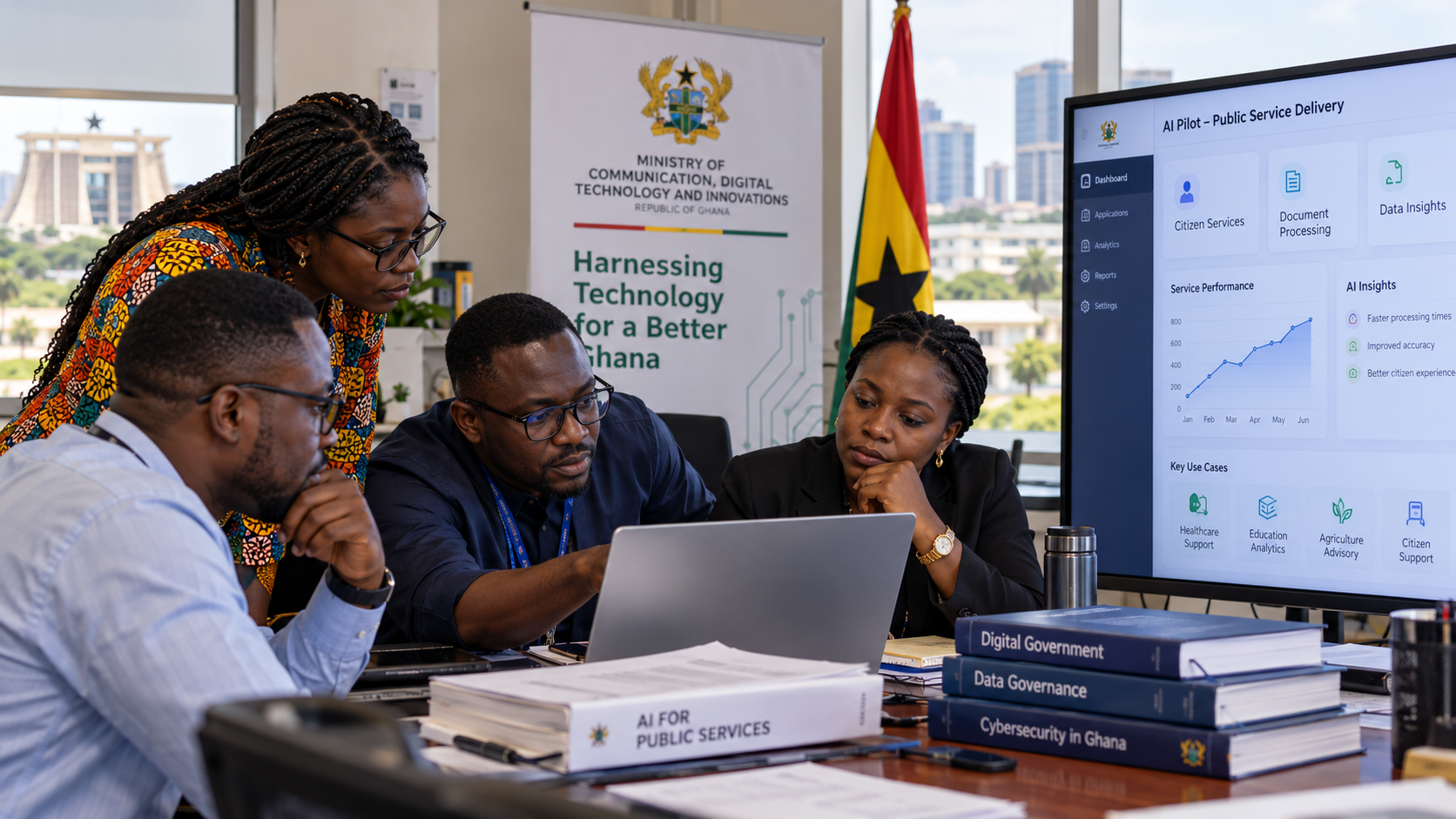
Imagine a government agency buying an artificial-intelligence system to process applications, analyse health information or automate public services.
The software works.
It looks impressive.
But then harder questions begin.
Where is the data stored?
Can the system work with other government platforms?
Who fixes it when something breaks?
And what happens if Ghana becomes permanently dependent on one foreign technology company to operate it?
Those are exactly the kinds of questions Ghana now wants answered before public institutions buy AI systems.
On October 2, government announced a new centralised technical review mechanism for public-sector AI acquisitions.
Under the new approach, government-acquired AI systems will be assessed before procurement against criteria including data protection, cybersecurity, interoperability, sustainability and local skills transfer.
That may sound like an internal government procedure.
It is actually a much bigger story about who controls Ghana’s AI future.
Government does not want agencies buying AI independently
AI adoption across Ghana’s public sector is accelerating.
Government has already said it wants artificial intelligence used across areas such as healthcare, agriculture, education, finance and public-service delivery.
Ghana’s National AI Strategy was formally launched in April 2026, with government positioning AI as part of the country’s broader digital transformation agenda.
But introducing AI across dozens of Ministries, Departments and Agencies creates a new problem.
What happens if every institution buys its own system?
One ministry could purchase software from one vendor.
Another agency could choose an entirely different platform.
A third could store sensitive information in a system that cannot communicate with anything else government uses.
The result could be expensive, fragmented technology infrastructure.
The new review mechanism is designed to reduce that risk.
According to the Information Services Department, the Ministry of Communication, Digital Technology and Innovations will coordinate the technical requirements for government AI purchases, while the National Information Technology Agency, NITA, will lead technical scoping.
In other words, public institutions will not simply be asking:
“Does this AI tool work?”
They will increasingly have to ask: “Does this AI tool make sense for Ghana?”
Vendor lock-in is one of the biggest concerns
One phrase in government's announcement deserves attention: vendor lock-in.
Vendor lock-in happens when an organisation becomes so dependent on one technology provider that switching to another becomes extremely difficult or expensive.
Imagine a government department storing years of data inside a proprietary AI platform.
The system becomes part of daily operations.
Staff are trained specifically to use it.
Other government applications are connected to it.
Then the provider increases its prices or changes its terms.
Leaving suddenly becomes very difficult.
That is the problem Ghana says it wants to avoid.
The government says the review process will assess interoperability, meaning AI systems should be able to work with other technologies instead of becoming isolated platforms controlled by one vendor. (ISD)
This is particularly important for public infrastructure.
Government technology can remain in use for years.
A bad purchasing decision made today could therefore create expensive problems long after the original contract ends.
Then there is the question of Ghanaian data
AI runs on data.
That makes government adoption particularly sensitive.
Public institutions can hold information about health, taxes, education, businesses and individual citizens.
If an AI system processes that information, Ghana needs to know where the data goes and who ultimately controls it.
The new government review will therefore examine data protection and data sovereignty.
Data sovereignty is essentially the idea that a country should maintain meaningful control over strategically important data generated within its borders.
That concern is already part of Ghana's wider AI strategy.
At the launch of the National AI Strategy, government said the framework would emphasise responsible AI, strong data governance, infrastructure development and public trust.
Earlier consultations also examined Ghana's readiness in areas including AI governance, digital infrastructure, data systems and ethical safeguards.
The question is therefore becoming increasingly practical:
Should Ghana use an AI system simply because it is powerful if the country cannot confidently control the data flowing through it?
Ghana also wants something back from foreign technology companies
Another interesting requirement is local skills transfer.
Government says AI acquisitions will be assessed partly on whether they contribute to developing Ghanaian expertise.
That matters because countries can adopt advanced technology without actually building the ability to maintain or develop it themselves.
A foreign company installs the system.
Its engineers manage it.
Its consultants troubleshoot it.
Its infrastructure runs the product.
The local institution becomes a customer rather than a technology owner.
Ghana appears to be trying to avoid that outcome.
The new framework calls for AI purchases to include meaningful local capacity building. (ISD)
That fits with another part of Ghana's current AI strategy: workforce development.
Government says its One Million Coders Programme had recorded more than 141,950 registrations by the time the procurement-review mechanism was announced. (ISD)
Government has also been running AI training for public officials.
In April, the Ministry launched a public-sector AI capacity programme with UNDP and Japan aimed at helping officials understand AI use cases, risks, governance and practical deployment.
The idea appears to be that Ghana should not simply buy AI.
It should gradually learn how to operate, evaluate and eventually build more of it locally.
Cybersecurity now becomes part of procurement
Security is another major reason the new review matters.
An AI system connected to government data can become an attractive target.
If it is poorly secured, the problem is not merely that the software may fail.
Sensitive information could be exposed.
Attackers could potentially interfere with automated systems.
Or government institutions could become dependent on technology they do not fully understand.
That is why cybersecurity will now be one of the benchmarks used to assess proposed AI acquisitions. (ISD)
This connects Ghana's AI policy with its broader effort to protect national digital infrastructure.
The faster government digitises services, the more important technology procurement becomes.
Buying the wrong system is no longer just an IT problem. It can become a national security problem.
This could also affect technology companies
The policy is not only relevant to government.
It changes what companies hoping to sell AI products to the public sector may need to demonstrate.
A vendor may have to show that its system:
- can integrate with existing government technology
- protects sensitive data
- meets cybersecurity standards
- remains sustainable over time
- does not create excessive dependency
- contributes to local skills development
That could create opportunities for Ghanaian technology firms.
Local companies may understand Ghana's institutions, regulations and infrastructure better than international vendors.
But it could also raise the technical bar for smaller startups trying to win government contracts.
That creates another important question:
Will stricter AI procurement rules help Ghanaian startups compete — or make public-sector contracts even harder for them to access?
The answer will depend heavily on how the review process is implemented.
Ghana is moving from AI enthusiasm to AI governance
For much of the past two years, Ghana's AI conversation has focused on opportunity.
Skills.
Startups.
Innovation.
Healthcare.
Agriculture.
Education.
Those conversations still matter.
But this new procurement mechanism signals something different.
Government is beginning to think about what happens after the excitement.
Who owns the systems?
Who controls the data?
Can one platform communicate with another?
Can Ghana maintain the technology without permanent foreign dependence?
And what happens when the AI system fails?
These questions are less exciting than launching a new AI programme.
They may also be more important.
The real test will be enforcement
A review mechanism on paper does not automatically produce good technology.
Government agencies will still have to follow it consistently.
Technical reviewers will need enough expertise to challenge powerful vendors.
Procurement decisions will need to remain transparent.
And standards will have to evolve as AI technology changes.
Ghana is also investing in supporting infrastructure, including an AI Compute Centre and upgrades to the National Data Centre, according to the government announcement. (ISD)
Those investments suggest the country wants to build more domestic capability rather than rely entirely on technology hosted elsewhere.
But infrastructure is only one part of the equation.
Governance may determine whether the technology actually serves the country.
Ghana has already decided that government should use AI.
The more interesting question now is:
Who gets to decide which AI Ghana trusts?
Writer at TechNews.


Comments 0
No comments yet — start the conversation.