Imagine waking up to find that your bank’s website is unavailable.
Frustrating, certainly.
Now imagine a cyberattack shutting down part of the electricity network, interfering with a water-treatment system or disrupting equipment inside a hospital.
That is a very different kind of problem.
And it is one Ghana is beginning to pay much closer attention to.
In October, the Ministry of Communication, Digital Technology and Innovations said Ghana must move beyond protecting websites, databases and office computers and focus more seriously on the technology that keeps essential physical services running. Read the Ministry’s announcement on critical infrastructure cyber resilience
The shift could become one of the most important parts of Ghana’s cybersecurity strategy.
The threat is moving beyond computers
For years, cybersecurity conversations have mostly focused on information technology.
Think hacked emails, stolen passwords, ransomware and leaked customer databases.
Those threats are still serious.
But many of Ghana’s most important services depend on another category of technology known as operational technology, or OT.
These are the systems that interact with physical equipment.
They can include industrial control systems, sensors and SCADA systems used to monitor and control infrastructure such as electricity, water and industrial facilities.
If someone compromises an ordinary office computer, information may be stolen.
If an attacker compromises the system controlling physical infrastructure, the consequences could move from the screen into the real world.
That is why the Communications Ministry is now putting more emphasis on resilience.
Ghana has identified about 200 critical institutions
The government says Ghana currently has 13 designated Critical Information Infrastructure sectors and about 200 institutions identified as Critical Information Infrastructure owners.
These cover services whose failure could have serious consequences for the country.
The sectors include areas such as energy, water, healthcare, transportation and financial services.
The concern is straightforward.
As these industries become more digital, they also become more connected.
And connected systems create new points of attack.
A hospital using connected medical systems can operate more efficiently.
A power company using digital monitoring can detect problems faster.
A bank connected to national payment infrastructure can process transactions instantly.
But every new connection also creates something that must be protected.
The question is no longer simply whether Ghana can digitise its essential services. It is whether those services can remain available when someone tries to disrupt them.
“Prevent every attack” may no longer be realistic
One of the most interesting parts of Ghana’s new cybersecurity thinking is the emphasis on resilience rather than simply prevention.
Cybersecurity traditionally asks:
How do we stop attackers from getting inside?
Resilience asks another question:
What happens after they get in?
Government says critical institutions need to be able to anticipate threats, withstand attacks, restore services quickly and adapt when vulnerabilities are discovered.
That is an important difference.
No organisation can guarantee that it will never be attacked.
The real test may be whether an attack can shut down an essential service for hours, days or weeks.
For electricity, water or healthcare, recovery time matters enormously.
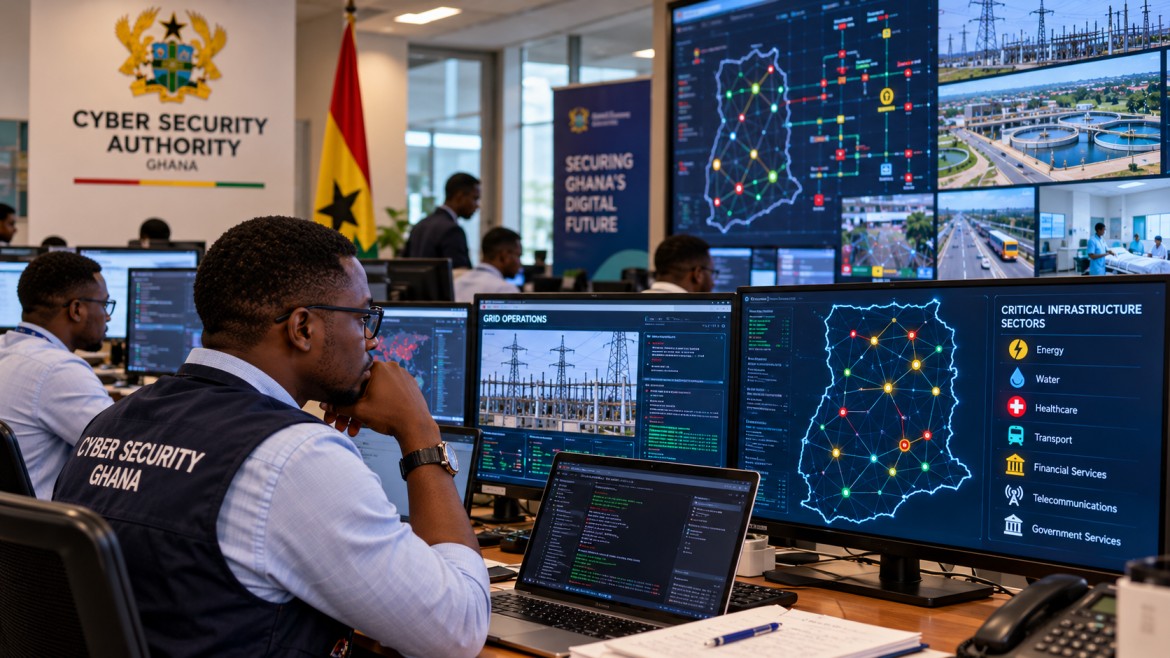
Ghanaian cybersecurity analysts monitor critical infrastructure sectors including energy, water, healthcare, transport and telecommunications.
Cybersecurity is becoming a boardroom problem
Another change is who government expects to take responsibility.
Cybersecurity has often been treated as something for the IT department.
The Communications Ministry says that approach is no longer enough.
Board chairs, chief executives and institutional leaders are being told that cyber resilience must become an organisation-wide responsibility rather than something delegated entirely to technical staff.
That makes sense when technology becomes central to operations.
If a cyberattack can stop a company from delivering its core service, then cybersecurity is no longer simply a technical expense.
It becomes a business continuity issue.
The problem is also appearing outside Accra
Ghana’s cybersecurity push is increasingly being linked with telecommunications expansion outside the capital.
During an October visit to the Volta Region, the Communications Ministry said it was working toward establishing a permanent regional headquarters for cybersecurity and data-protection operations. See the Ministry’s Volta Region digital infrastructure update
The same visit examined telecom infrastructure, digital-skills centres and rural connectivity.
That connection is important.
The more communities Ghana connects to digital services, the more people become dependent on those systems.
Expanding connectivity therefore creates two responsibilities at once:
getting people online and keeping the systems they rely on secure.
AI makes the problem even harder
Artificial intelligence adds another layer.
AI can help organisations detect suspicious behaviour and analyse large amounts of security information.
But attackers can also use AI to automate phishing, generate convincing scams and search for vulnerabilities faster.
The Communications Ministry has acknowledged that Ghana’s policy and regulatory frameworks will need to remain responsive to emerging AI-enabled cyber threats.
That means Ghana is effectively running two races at once.
It is digitising more of the economy while trying to make that increasingly digital economy harder to attack.
The real challenge is implementation
Ghana already has cybersecurity laws, regulators and designated critical infrastructure.
The difficult part is making sure institutions actually implement the required protections.
That requires trained professionals.
It requires regular security testing.
It requires backup systems.
It requires organisations to know which equipment is connected to their networks.
And perhaps most importantly, it requires planning for failure before failure happens.
The Ministry has said government will continue supporting the Cyber Security Authority’s enforcement mandate and building Ghana’s cybersecurity workforce.
But regulation alone cannot keep electricity running during an attack.
The institutions operating the infrastructure have to be ready too.
Ghana’s digital future depends on what happens offline
Digital transformation is usually discussed in terms of faster internet, AI, mobile payments and online government services.
Cyber resilience exposes the other side of that transformation.
The more Ghana depends on technology, the more technology becomes part of national infrastructure.
A cybersecurity incident can therefore become a healthcare problem, an energy problem, a transportation problem or a financial-services problem.
That is why Ghana’s next cybersecurity battle may not happen on a website at all.
It may happen inside the systems keeping the country running.
And the real measure of Ghana’s cyber readiness will be whether those systems continue working when something goes wrong.
Writer at TechNews.

Comments 0
No comments yet — start the conversation.