
Imagine opening one app and seeing your bank account, mobile-money wallet, loan history and spending patterns in one place.
Or applying for a financial product without printing months of statements because, with your permission, the provider can securely access the information it needs.
That is the idea behind open banking.
And Ghana is now moving closer to it.
On October 9, the Bank of Ghana published a Draft Open Banking Directive as part of its push to expand digital financial services and improve competition in the financial sector. Bank of Ghana
The directive could change how banks, fintechs and payment providers access and use financial data.
But it also raises an important question:
How much of your financial information should another company be allowed to see — even if you give permission?
First, what exactly is open banking?
Open banking allows financial institutions to securely share customer-approved financial data with other regulated providers through technology called Application Programming Interfaces, or APIs.
The Bank of Ghana’s draft says the goal is to allow regulated financial institutions to exchange customer-consented data securely and use that information to offer more personalised financial products and services. Bank of Ghana
In simple terms, your financial information would no longer have to remain locked inside one bank.
With your permission, another approved institution could access specific information and use it to provide a service.
That does not mean companies would automatically be allowed to browse your financial life.
Consent is central to the proposal.
What information could be shared?
The draft directive covers several types of data.
These include:
- personal information used for identification and Know Your Customer checks
- account information
- transaction history
- payment information
- credit data
- publicly available information about financial products and markets
The Bank of Ghana says the information must only be shared after the customer gives explicit consent. Bank of Ghana
That could make some financial services much easier.
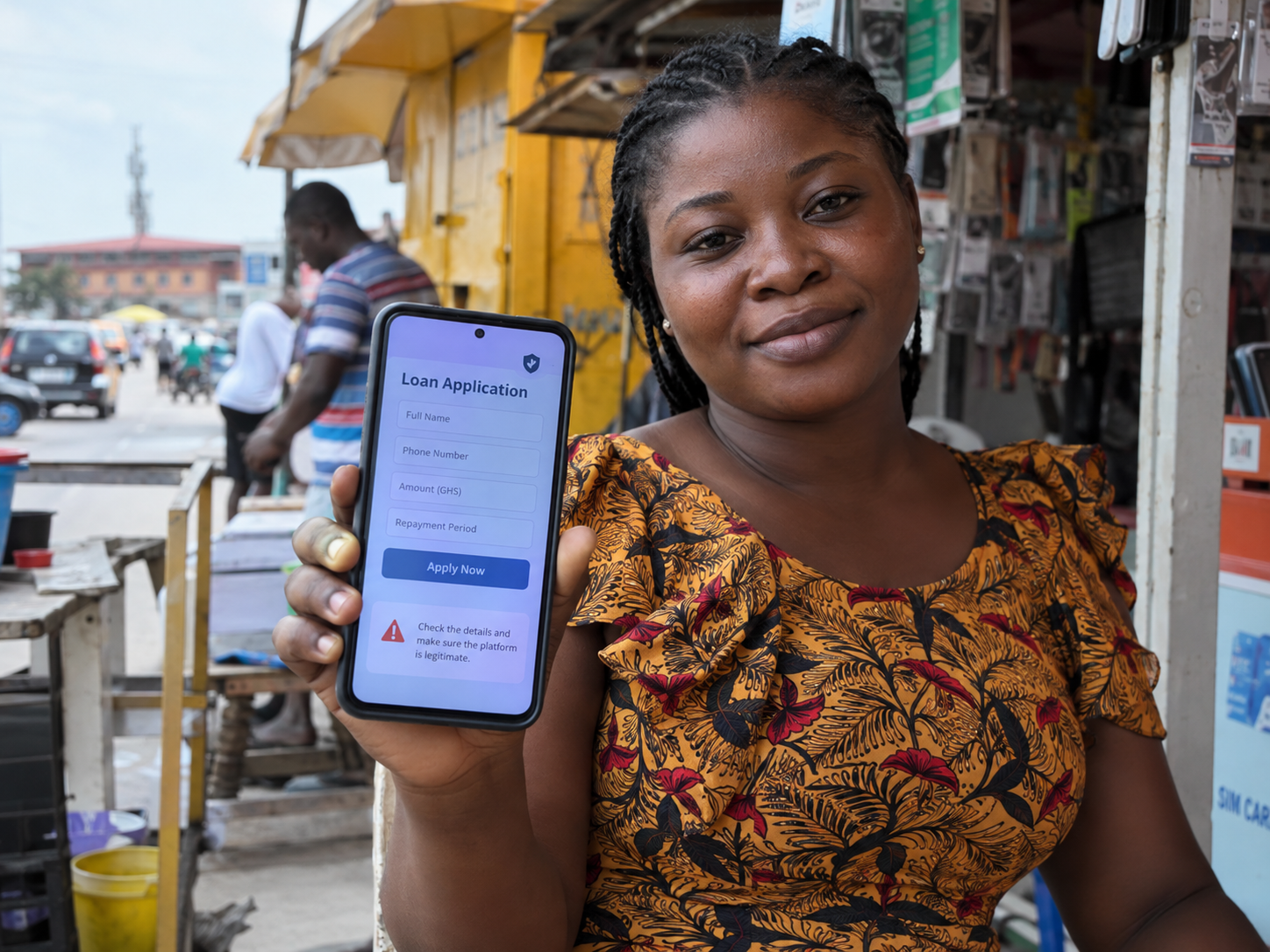
For example, imagine applying for a loan from a fintech.
Instead of uploading bank statements manually, you could authorise the provider to access the specific transaction or credit information it needs.
A budgeting app could potentially bring information from several financial institutions together.
A fintech could analyse your financial behaviour and offer a savings product designed around how you actually spend.
The possibilities are significant.
So are the risks.
Ghana is already highly connected financially
Open banking would not be starting from zero.
Ghana already has a growing interoperable payments system.
Through Mobile Money Interoperability, users can move money between mobile-money networks and between wallets and bank accounts. GhanaIPS
GhIPSS Instant Pay also allows real-time transfers between financial institutions. GhanaIPS
And the system continues to grow.
According to GhIPSS, transactions across its platforms increased by 32.61% to 319.85 million during the first half of 2026, while transaction value exceeded GH¢1 trillion for the first time in a half-year period. GhanaIPS
Open banking could take this one step further.
Ghana has already worked on making money move between institutions.
The next phase is making data move securely too.
The Bank of Ghana wants a central data exchange
One of the most interesting parts of the proposal is something called OpenDX, or Open Data Exchange.
The draft says OpenDX would become the public digital infrastructure through which participating financial institutions securely exchange approved customer data.
It would manage API standards, data formats, consent requests, encryption and the registry of participating institutions. Bank of Ghana
The proposed system would include banks, savings and loans companies, rural and community banks, microfinance institutions, electronic-money issuers, payment service providers and other financial-technology companies approved by the Bank of Ghana. Bank of Ghana
That could create a much more connected financial ecosystem.
Instead of every fintech negotiating a different technical integration with every bank, institutions could operate around shared standards.
For startups, that could make it easier to build new products.
Consent is supposed to be the gatekeeper
The biggest concern will naturally be privacy.
The draft directive includes several safeguards.
Customers must give explicit and informed consent before their information is accessed.
That consent would apply to specific institutions and specific data.
Giving one company permission does not automatically give every company permission.
Customers would also be able to revoke access at any time. Bank of Ghana
The draft states that consent should not automatically renew and should last no longer than one year before fresh consent is required. Bank of Ghana
Data must also be encrypted, and institutions would be required to maintain records showing who accessed customer information and when. Bank of Ghana
These protections matter because open banking only works if customers trust the system.
Would you allow a fintech to see your transaction history if doing so meant getting a better loan rate or a more useful financial service?
That may eventually become a very real decision for Ghanaian consumers.
Fintechs could be among the biggest winners
Ghana's fintech sector is already expanding.
The Bank of Ghana says the number of licensed Payment Service Providers increased from 57 in 2024 to 64 in 2025, while it received 292 fintech-related applications during the year. Bank of Ghana
Open banking could give those companies new ways to compete.
A smaller fintech may not have millions of customers or decades of banking history.
But with customer consent, it could potentially access enough financial information to build better lending, savings, payment or financial-management products.
That could increase competition with traditional banks.
And that is one of the Bank of Ghana's stated objectives: innovation, financial inclusion and greater competition among regulated financial institutions. Bank of Ghana
Alt text: A man operating an ATM Machine
But more connected systems create new risks
Open banking could make financial services more convenient.
It could also create more places where something can go wrong.
A poorly secured API could expose sensitive information.
A customer could approve access without fully understanding what they are sharing.
A company could potentially collect more information than it needs.
Cybercriminals may also target open-banking systems because financial data is valuable.
The draft therefore requires participating institutions to use secure authentication, including multi-factor authentication, and to comply with Ghana's Data Protection Act and Cyber Security Act. Bank of Ghana
The technology is important.
But implementation will matter even more.
What happens next?
For now, this is still a draft directive, not the final version.
That distinction is important.
The Bank of Ghana published it as part of the process of developing Ghana's open-banking framework. Bank of Ghana
If the system moves forward as proposed, Ghana could enter a new phase of digital finance.
The country's first major fintech transformation made it easier to move money.
Mobile-money interoperability connected wallets and banks.
Instant payments made transfers faster.
Open banking could now make financial data more portable too.
That creates opportunities for fintechs, banks and consumers.
But its success will depend on something much less technical:
whether Ghanaians trust companies enough to let their financial data move as freely as their money now does.
Writer at TechNews.


Comments 0
No comments yet — start the conversation.