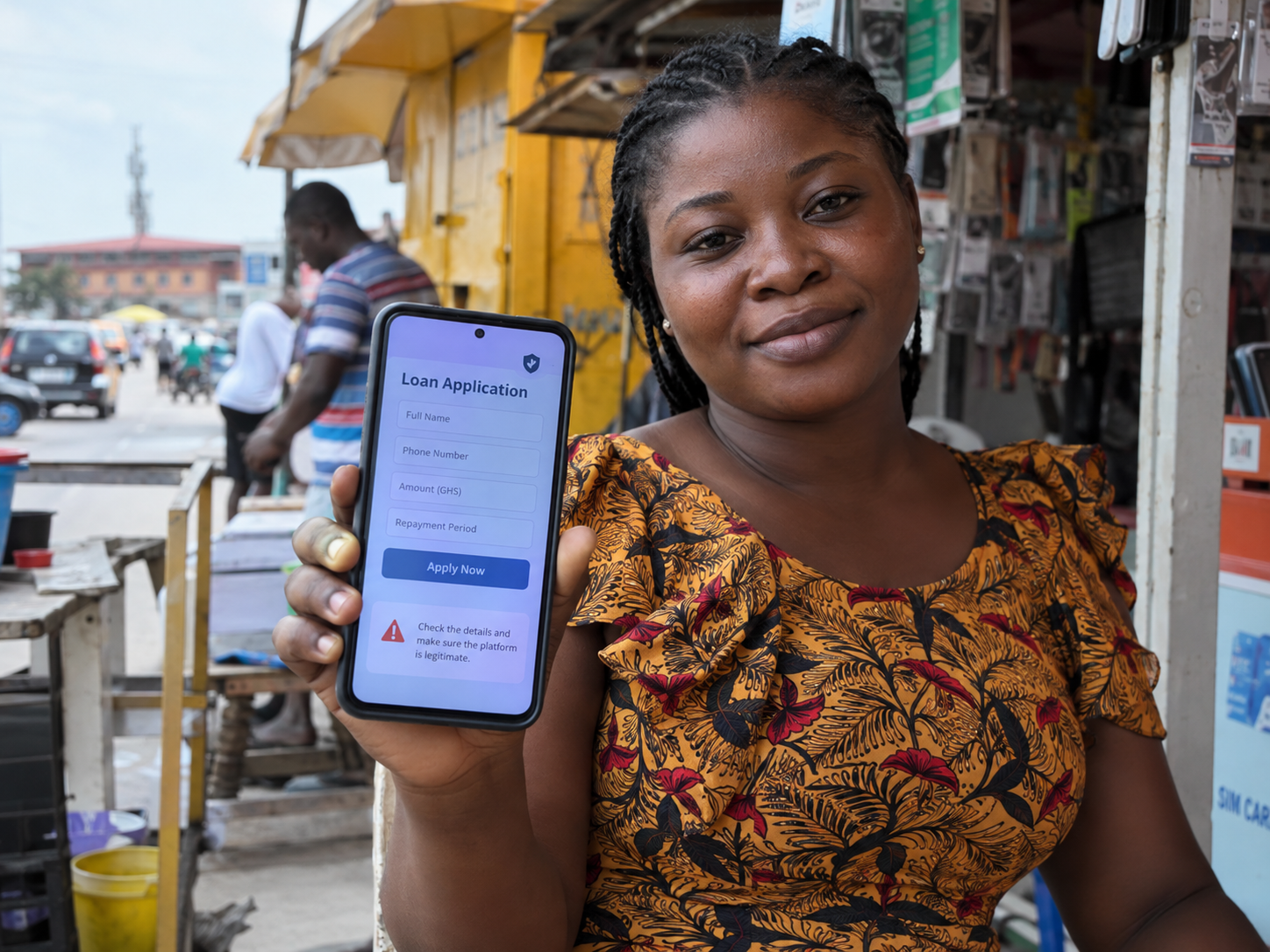
You need GH¢500 before payday.
You download an app, enter a few details and, within minutes, money appears in your account.
No bank queue. No paperwork. No lengthy interview.
That convenience has helped digital lending grow in Ghana.
But it has also created another problem: how do you know the loan app on your phone is actually authorised to operate?
The Bank of Ghana is now trying to make that answer much clearer.
In October 2026, the central bank published another notice identifying 20 mobile loan applications operating without the required licence or authorisation.
The list included apps such as Agile Loan, CashWay, NovaCedi, Palm Loan, PocketLoan, SikaNow and Zatuloan.
See the Bank of Ghana's October 2026 notice on unlicensed digital lenders
The message from the regulator is becoming increasingly direct: Digital lending in Ghana is no longer a space where anyone can simply launch an app and start issuing loans.
What counts as digital credit?
The Bank of Ghana defines digital credit as short-term, relatively low-value credit delivered through digital channels such as mobile apps and websites.
Under its current framework, digital credit generally covers loans lasting less than 12 months, with a maximum loan amount of GH¢10,000. (Bank of Ghana)
That could include the small emergency loans people take through their phones for bills, food, business expenses or other short-term needs.
The attraction is obvious.
Digital lending can make credit available to someone who may not qualify easily for a traditional bank loan.
But speed can also hide the true cost.
A borrower may focus on how quickly the money arrives and pay less attention to fees, interest, repayment conditions or what happens when they miss a payment.
When borrowing money takes only a few taps, are people being given enough time and information to understand what they are agreeing to?
That is one of the problems regulation is supposed to address.
Ghana now has a licence specifically for digital lenders
The Bank of Ghana has formally designated Digital Credit Services as a non-bank financial service.
A company that wants to operate exclusively as a digital lender must therefore obtain a Digital Credit Services Provider licence from the central bank. (Bank of Ghana)
The regulator says the framework is intended to improve:
- consumer protection
- responsible lending
- data privacy and security
- access to credit
- transparency
- proper licensing of providers
Read the Bank of Ghana's Digital Credit Services FAQs
Companies applying for a licence must use the Bank of Ghana's Online Regulatory Analytics Surveillance System, known as ORASS. (Bank of Ghana)
This means the regulator is moving digital lending from an informal app-based market into a more recognisable part of Ghana's financial system.
The crackdown has already started
The Bank of Ghana had previously given existing unlicensed mobile-loan providers until June 30, 2026 to regularise their operations.
When that deadline expired, it warned that companies continuing to operate without authorisation could face regulatory action. (Bank of Ghana)
Since then, the central bank has continued publishing notices about unlicensed providers.
Its October notice says some unauthorised loan apps pose concerns around customer data privacy, consumer protection and compliance with regulatory standards. (Bank of Ghana)
That matters because a lending app may collect much more than a borrower's name.
Depending on the permissions requested, a mobile application could potentially seek access to information stored on a phone.
That is why data protection has become as important to digital lending as interest rates.
There are already approved digital-loan products
Not every digital lender is operating outside the system.
The Bank of Ghana maintains an official list of approved digital credit products and applications.
The list includes products offered through banks, microfinance companies, fintechs and mobile-money platforms.
Examples include digital-credit services associated with institutions such as Absa Bank Ghana, CalBank, Consolidated Bank Ghana, Ecobank, Fidelity Bank, Fido, Republic Bank, Telecel Ghana Mobile Financial Services and Zenith Bank Ghana. (Bank of Ghana)
For consumers, that list could become increasingly important.
Before downloading a random lending app because an advert promises “instant cash,” borrowers can check whether the product appears on the regulator's approved list.
But regulation will not remove the demand
There is a reason these apps exist.
People need short-term credit.
A worker may need money before salary day.
A trader may need GH¢1,000 to restock.
A student may suddenly need money for an urgent expense.
Traditional lending does not always serve those needs quickly.
Digital credit does.
That means simply shutting down unlicensed apps will not solve the underlying problem.
Regulated lenders will have to offer alternatives that are easy enough, fast enough and affordable enough to convince customers not to return to informal providers.
This creates an opportunity for Ghanaian fintech companies.
Companies that can combine responsible lending with fast digital experiences could serve customers who are currently caught between traditional bank loans and questionable mobile apps.
The real issue is not whether digital lending should exist
Digital lending is unlikely to disappear.
If anything, it could become more important as Ghana's financial system becomes increasingly digital.
The Bank of Ghana is simultaneously working on areas such as open banking, instant payments and financial-data sharing.
Better financial data could eventually allow lenders to make more informed credit decisions instead of depending only on traditional collateral or salary history.
That could mean faster loans for legitimate borrowers and more personalised credit products.
But it could also make financial data extremely valuable.
The more lenders know about customers, the more important questions about consent, privacy and responsible use become.
What borrowers should watch
The simplest change for consumers is also the most important:
Do not assume that an app is legitimate simply because it appears in an app store.
The Bank of Ghana advises people to deal only with licensed or authorised providers and says it will maintain information on approved digital lenders. (Bank of Ghana)
Before taking a loan, borrowers should also understand:
- the total amount they will repay
- the interest and fees
- when repayment is due
- penalties for late repayment
- what personal information the app collects
Those questions become even more important when obtaining credit takes less than five minutes.
Ghana's digital-loan market is growing up
Mobile money changed how Ghanaians move cash.
Fintech changed how people make payments.
Digital lending could change how millions of people access credit.
But credit is different.
A failed payment is frustrating.
A badly structured loan can leave someone in debt.
That is why Ghana's current crackdown matters.
The Bank of Ghana is not trying to eliminate digital lending. It is attempting to draw a clearer line between companies allowed to offer it and those operating outside the regulatory framework.
The challenge now is whether consumers will know the difference.
Before tapping “Get Loan,” the most important question may no longer be how quickly the money will arrive — but who is actually behind the app.
Writer at TechNews.



Comments 0
No comments yet — start the conversation.