Imagine buying a 5G phone in Ghana, seeing the 5G symbol in advertisements, but still wondering whether the network will actually be fast, reliable and widely available where you live.
That question is becoming more important because Ghana has quietly changed how it plans to build its 5G future.
In July 2026, the National Communications Authority removed the exclusive rights previously granted to Next Gen Infraco Limited, or NGIC, to operate as Ghana’s sole wholesale 5G infrastructure provider.
Read the NCA’s decision on NGIC’s 5G licence The change opened the door to more competition. And just two months later, telecom companies were already competing for new spectrum that will shape Ghana’s next phase of mobile broadband.
Why did Ghana change its 5G model?
Ghana’s original 5G approach was built around a shared wholesale network.
NGIC was given the exclusive right to own and operate wholesale 5G infrastructure, while mobile operators would access that network rather than each building separate infrastructure.
The idea was to reduce duplication and accelerate rollout.
But in March 2026, the NCA signalled that it wanted to change that model.
The regulator said greater competition could improve investment, innovation, consumer choice and service quality. (NCA)
At the time, the NCA said NGIC had installed only 49 5G sites across Ghana.
Of those, 43 were in Greater Accra, while Ashanti, Western, Northern, Bono and Central regions had only a handful between them.
That concentration raised an obvious question:
Can Ghana call 5G a national transformation if most of the infrastructure remains concentrated in Accra?
The NCA ultimately decided that a more competitive model would better serve the public interest.
The amendment took effect on July 15, 2026.
NGIC still keeps its other licence rights and existing spectrum, but it is no longer the only company allowed to operate wholesale 5G infrastructure. (NCA)
Ghana then opened new spectrum
The next step was spectrum.
Spectrum is the invisible radio frequency mobile networks use to carry voice and data.
Think of it like lanes on a highway.
More spectrum can give network operators more capacity to carry traffic, especially as people stream video, use cloud services and connect more devices.
After changing NGIC’s exclusive licence, the NCA opened applications for spectrum in three bands:
- 700 MHz
- 2.3 GHz
- 3 GHz
These bands can be used for mobile broadband services, including 5G. (NCA)
By the application deadline in August, the regulator had received four submissions. (NCA)
Three applicants later qualified to continue.
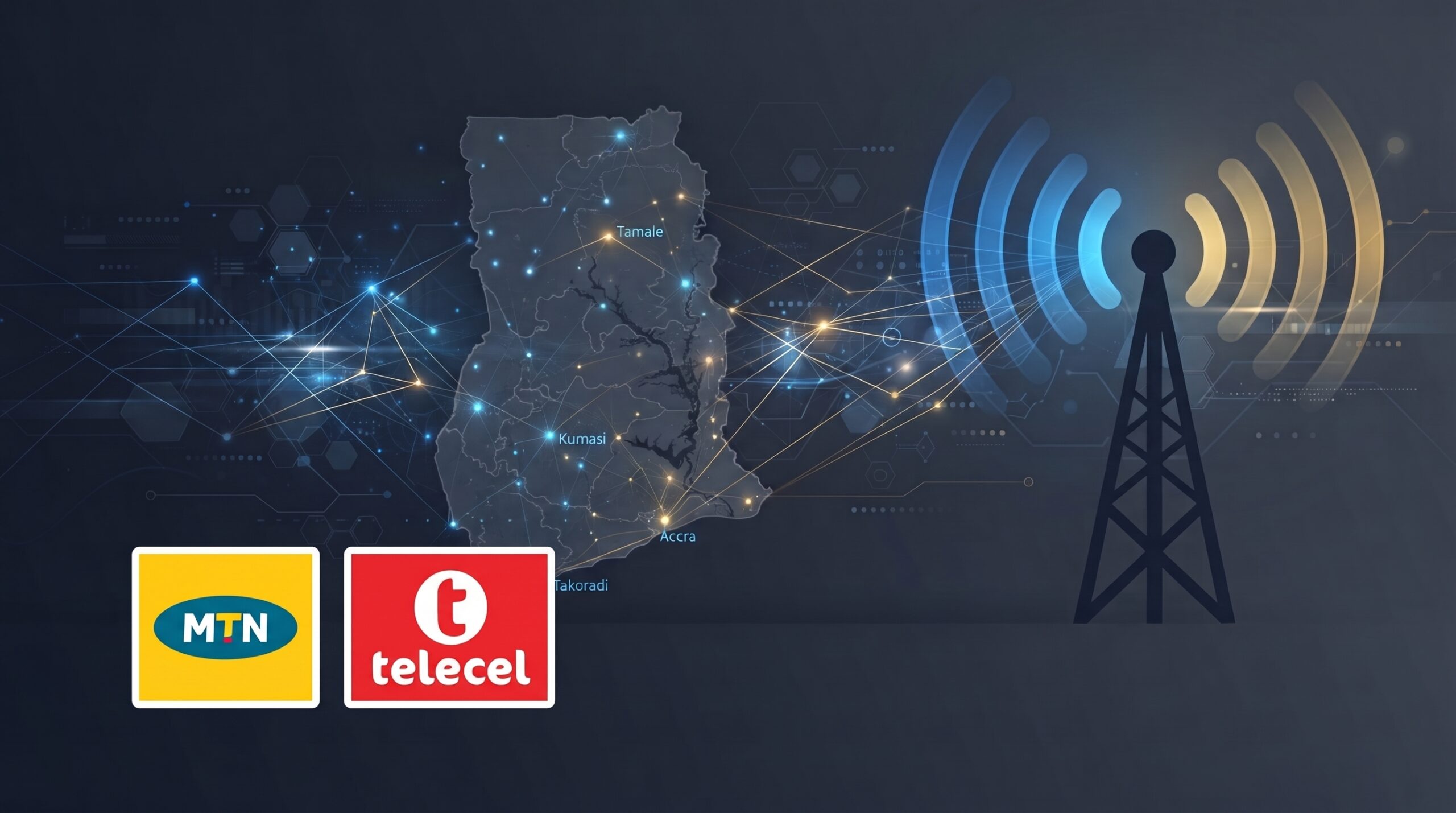
They included MTN Ghana, Telecel Ghana and Goal Telecommunications. (NCA)
MTN has already spent big
The most striking result so far came from the 700 MHz band.
MTN Ghana was the only qualified applicant for that band and applied for the maximum two lots allowed.
Those two lots generated a total licence fee of US$100.9 million, according to the NCA. (NCA)
That number matters.
It signals that Ghana’s biggest mobile operator sees real value in expanding its spectrum holdings for future mobile broadband and 5G services.
The 700 MHz band is particularly important because lower-frequency spectrum can travel farther and penetrate buildings better than many higher-frequency bands.
In practical terms, that can make it useful for broader coverage.
Telecel and MTN are competing elsewhere
The 3 GHz band is a different story.
The NCA said there were three available lots but applications for four, meaning demand exceeded supply.
Both MTN Ghana and Telecel Ghana qualified for that band. (NCA)
The 2.3 GHz band was under-subscribed, with four applications for five lots.
Telecel Ghana and Goal Telecommunications were among the qualified applicants for that band.
The regulator said it would announce the final results after completing the remaining stages of the process.
That means Ghana’s 5G market is still evolving.
Will more competition actually improve 5G?
This is the most important question.
Competition can encourage companies to invest more aggressively.
Operators may build more sites, improve coverage and compete on speed and service quality.
But spectrum alone does not guarantee better internet.
Companies still need:
- fibre backhaul
- towers
- power
- equipment
- affordable devices
- enough customers willing to pay for 5G services
A network can own valuable spectrum and still deliver a poor customer experience if the infrastructure underneath it is weak.
That is why Ghana’s 5G story cannot simply be measured by how many licences are issued.
The better measure will be what users actually experience.
Will someone in Tamale, Takoradi or Sunyani experience the same improvement as someone in Accra?
That will be a much harder test.
5G also needs affordable devices
There is another issue operators cannot ignore.
A 5G network is not useful to someone whose phone only supports 4G.
Many 5G-capable devices remain more expensive than basic smartphones.
For mass adoption, Ghana will need more affordable 5G phones alongside wider network coverage.
Otherwise, 5G risks becoming a premium service used mostly by people with expensive devices in major cities.
The technology may exist.
But access could still be unequal.
Why this matters beyond faster downloads
5G is often marketed as “faster internet.”
That is only part of the story.
The technology can also support:
- cloud applications
- smart factories
- connected transport
- telemedicine
- Internet of Things devices
- high-quality video
- remote work
- AI-powered services
For businesses, faster and more reliable connectivity can affect productivity.
For startups, it can enable products that depend on low-latency or always-connected services.
And for government, better digital infrastructure can improve public services.
That is why Ghana’s 5G policy is really an infrastructure story, not just a telecom story.
Ghana’s next test is execution
The policy direction has changed.
Competition is increasing.
New spectrum is being assigned.
Operators are spending significant amounts of money.
Now comes the difficult part.
Ghanaians need to see actual improvements in network performance, coverage and affordability.
If the new model leads to faster rollout and more investment outside Accra, the change in policy may prove significant.
If coverage remains limited and prices remain high, the structure of the market will matter much less to ordinary users.
Ghana has already changed how it plans to build 5G.
The next question is whether users will actually feel the difference.
Writer at TechNews.

Comments 0
No comments yet — start the conversation.